The garden is all cleaned up and put to “bed” for the 2023 Harvest Season. This feat was accomplished by Halloween which is a record for our small, family-farming operation. As a result I have time to delve into the many projects I have been postponing. Hang on . . . here we go . . .
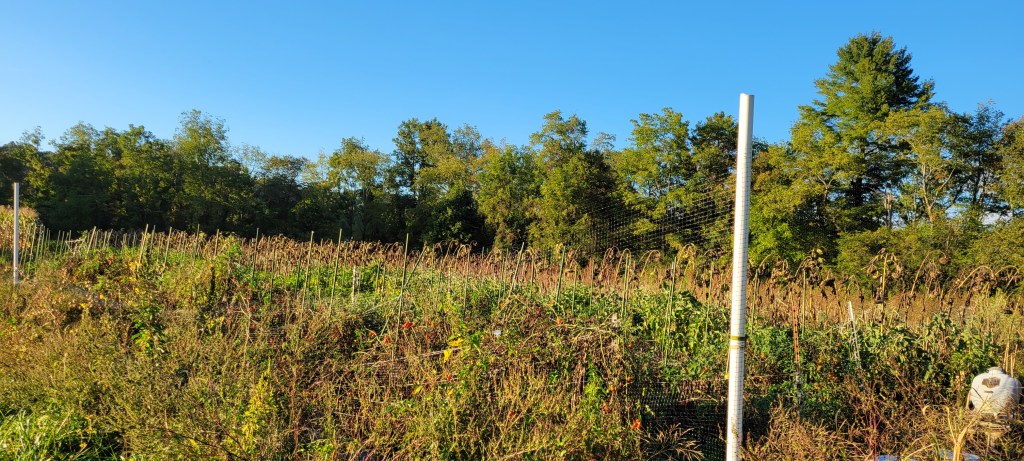
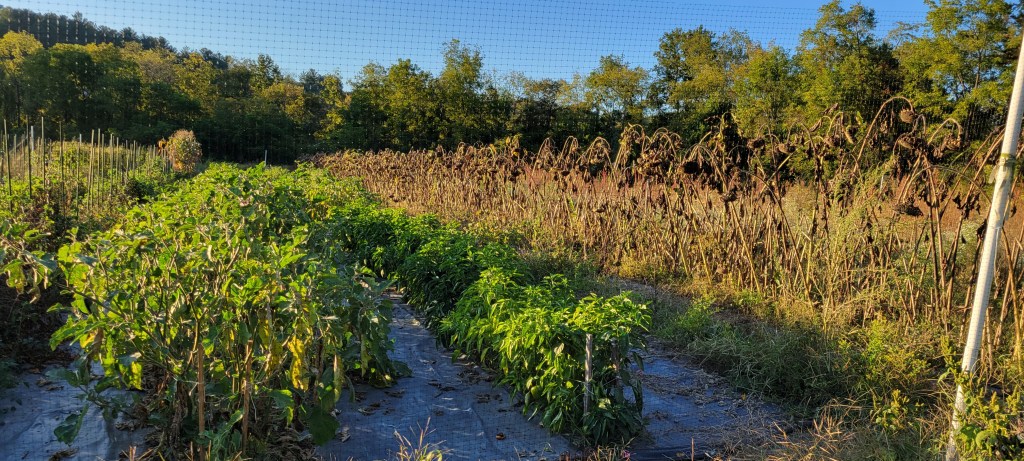
Stakes, poles, fences, fabric, ground staples and debris all removed for the winter!
Congress is currently considering 50 bills in both chambers that, collectively, would promote significant proliferation of wireless antennas and infrastructure across the country and in space, leading to higher levels of wireless radiation in the environment under the auspices of H.R. 3557: American Broadband Deployment Act of 2023. There are many reasons that we the public and our local authorities must tell Congress this and related bills are unacceptable!
As farmers, we feel these various legislation’s would encourage wireless radiation in agriculture, which depends on pollinators. As Members of a CSA, we trust you understand the importance of pollinators. All of the vegetables we grow for you depend on pollinator insects – bees, wasps, and butterflies. (This was one of the reasons for our decision to “opt out” of all “smart meters” on our property.) Fully three-quarters of our crops depend on pollinators to some extent, but only one-third of global crop production does. This is because many of the largest producing crops (staples such as cereals) are not dependent on them at all. WE like to eat vegetables from A to Z.
But let me get more “into the weeds” of these bills being written by the telecom industry lobbyists. Their entire construct is designed to strip all power from public, state, and local representatives as well as the general public (YOU) with regard to all meaningful discretion or choice on the placement, operation, and oversight of the telecom facility. Additionally, they want dispute settlements to be taken from the Federal Court and given to the FCC. The FCC which is fully captured by the telecom industry under BOTH POLITICAL PARTIES.
Telecom is NOT a public utility–it is a Common Carrier. Wireless is a commercial facility, but HR3557 (in particular) gets rid of restrictions in an attempt to make it a public utility. These bills speak to private wireless service, public wireless service, wired, and cable as well as all permits including land use permits, building permits, and all safety requirements. These bills are designed to swamp the local jurisdictions (City Council, County Commissioners, etc. with what they need to do under the Open Meeting Act) to benefit the telecom industry. In other words, things get technical and full of legality really quick.
Additionally, these bills represent an attempt of significant violations by the telecom industry of the Commerce Clause, Separation of Powers, and CONSTITUTIONAL VIOLATIONS of First, Fourth, Fifth, Seventh, Ninth, Tenth, Eleventh, and Fourteenth Amendments!!
This battle is not hopeless! The public votes!! Everyone just needs to communicate with the House and Senate Congressmen we elected into office in order to defeat these deceptive bills–because right now they are only hearing from the telecom industry lobbyists. Please share this legal challenge with others!
For Fact Sheets go here. To see the status of legislation visit Congress.gov . You can also find NC Senators and Representatives here under “Contact Him” for email and/or snail mail. The main Capitol Switchboard Numbers are Senate: 202-224-3121 and House: 202-225-3121. Please do some research and “make yourself a bother” to your representatives to stop the telecom industry.
I won’t show you a photo of the season’s end gardens. They look pretty much the same as the last time I posted. It takes an extraordinary amount of time to break down the entire project and this is Robert’s second job, after all. He calls it his “hobby” and say he is going to “play” in the garden! LOL Looking at the labor in this manner seems to make the work a bit easier. Meanwhile, I am still looking for the bottom of my desk. My “To Do List” seems to grow during growing season every bit as much as the vegetables. I put off and reschedule where I can, but the time of reckoning has arrived.
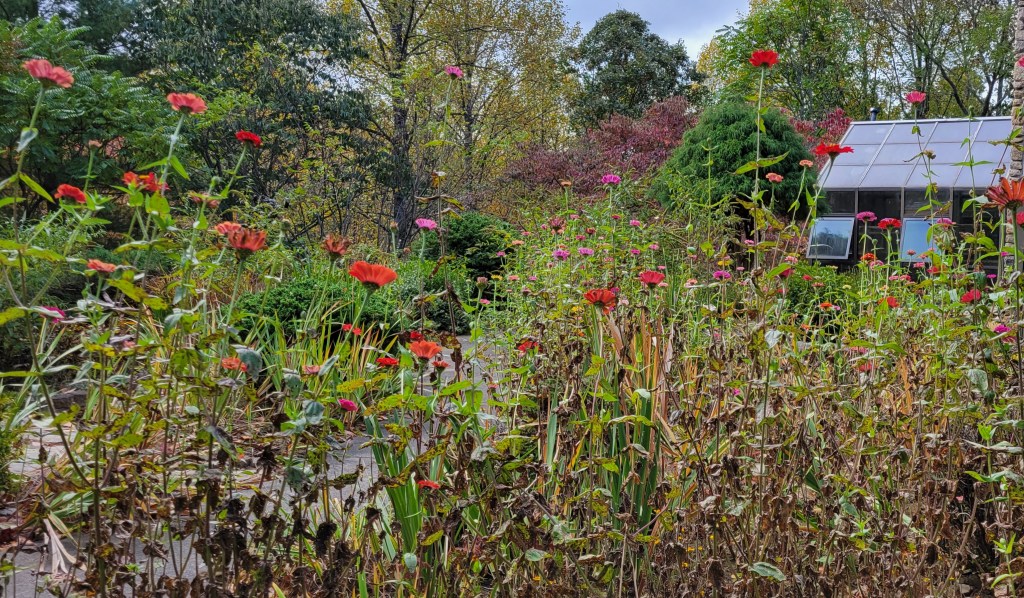
Until a big, hard frost . . . October Flowers!
We feel we were able to provide very good veggies during the 2023 Harvest Season! Our last veggie boxes had carrots, cabbage, green beans, peppers, tomatoes, potatoes, and spaghetti squash! Those CSA Members who have been with us for 18 to 20 (or more!) years know that all years are not as bountiful as the one we just experienced. And you know that individual crop failures are not permanent. For example, there were no onions or beets in 2023 as these crops were located in what turned out to be a wet area after that three-inch rain we got one day in mid-May. We have stewardship over our land and a relationship with our garden–not dominion over it; thus, we go with the flow!
Gardening teaches us to not focus on the negative for doing this will cause us to not see the good things happening all around. All of life is full of ups and downs. One’s resolution must be to find beauty in all events including chaos. Each day and each season is an opportunity for a fresh start–full of hope! And hope is a good thing. We are so grateful and blessed to have you as recipients of our bounty!
We are receiving inquires for the 2024 Harvest Season. You know the first shares are always offered to our previous year’s CSA Members. I shall be in touch in due time. In the mean time, enjoy the fall. And I pray for just one big snow which begins on a Friday! That is all I need to experience winter.
By now all CSA Members should have received their End of Season email from me. We did a gradual close down of the CSA much like we did a gradual start up last May. Sometimes, it seems these last five months have flown by! And at other times, Robert and I know we have been planting, tending, and harvesting since early March.
It has been fun getting to know all of you these past few months! Most of you have already indicated you want to continue in our CSA for the 2024 Harvest Season. However, just because life changes, I will be asking everyone again–probably in February 2024.
It seems work on the farm is never completed. Robert will soon begin dismantling the deer fence with its poles, the bean fence, the tomato stakes, and the eggplant and pepper stakes, the rows of fabric and the many, many hundreds of staples which have been holding it in place since March. Every single item of our growing season infrastructure must be removed in other words!
Robert and I think this has been one of the most successful harvest seasons we have enjoyed. And just as we are always excited to begin the planting season, we are also equally excited to end the harvest season. Patience and persistence are necessary traits for any gardener. And some growing seasons are better than others; but, there are always some lessons to be gleaned from a garden!
Our gardens look very sad today . . . but they definitely had their Glory Days in 2023!
This is not news about our family farm–that will come later in the weekend. However, for your information, here are more details about the recent vote in the House of Representatives and what must happen next to keep our sources of food safe.
Representative Thomas Massie talks about keeping our food supply safe
We are so grateful to Representative Thomas Massie (KY) for once again standing strong for health freedom! Representative Massie uncovered our very own tax dollars being used to fund scientists who are trying to turn plants like spinach and lettuce into mRNA vaccine factories, creating a “transgenic edible vaccine.” He proposed an amendment to prohibit USDA funding of this dangerous research, and the measure passed the House of Representatives.We were able to take 10 minutes of his time to talk about how important this is, and what the battles ahead are. Watch as I get the latest from Representative Massie about his efforts to ensure our food supply is safe and protected from risky scientific experimentation.
Representative Massie is carrying the torch for health freedom. Make sure you and your friends are following SHF for updates and calls to action that will support his stand for our rights.
Vaccines Grown in Lettuce? Rep. Massie Asks House to Bar FDA, USDA From Funding Transgenic Edible Vaccines
The U.S. House of Representatives on Tuesday passed an amendment to the agricultural appropriations bill that prohibits funding for human and animal vaccines grown in genetically engineered plants. Rep. Thomas Massie (R-Ky.), who introduced the amendment, said he is concerned “we could really contaminate a lot of our food supply with unknown doses of vaccines that would deliver unknown dosages.”
The U.S. House of Representatives on Tuesday passed an amendment that would prohibit funding for transgenic edible vaccines — vaccines grown in genetically engineered plants for consumption by humans or animals.
The amendment, introduced by Rep. Thomas Massie (R-Ky.) to the agricultural appropriations bill H.R. 4368, would bar the U.S. Department of Agriculture (USDA) and the U.S. Food and Drug Administration (FDA) from funding the vaccines for fiscal year 2024.
A vote on the full bill in the House is still pending as of this writing.
In an interview with The Defender, Massie said he introduced the amendment after learning about a recent project in California, funded by a $500,000 grant from the National Science Foundation, that involves growing lettuce and trying to get the lettuce to produce mRNA vaccines that are intended to be consumed by humans who eat the lettuces.
Rep. Massie said he is concerned “that plants cross-pollinate and pollen from these modified plants, food-producing plants, could carry in the wind to other fields and contaminate them. And we could really contaminate a lot of our food supply with unknown doses of vaccines that would deliver unknown dosages.”
“Plants release pollen and it can go anywhere with the wind or with insects, and I just think it’s a bad idea,” he added.
Rep. Massie is right to be concerned,” Claire Robinson, managing editor of GMWatch, told The Defender. “Genetically engineering a potent immunogen into food plants is irresponsible in the extreme.” She added:
“All the usual risks of GM [genetically modified] plants — the DNA-damaging effects of the GM transformation process leads to changes in gene expression and biochemistry of the plant, which can include the production of toxins or allergens — apply to these vaccine-producing plants, with additional risks on top.
“In the case of vaccine-producing plants, you are intentionally engineering a plant to elicit an immune reaction. This increases the level of risk exponentially.”
‘Either they don’t work, or they are not safe, or both’
According to a 2013 scientific paper, transgenic edible vaccines “are prepared by introducing selected desired genes into plants and inducing these genetically modified plants to manufacture the encoded proteins.”
Such vaccines offer “several potential advantages” to conventional vaccine production techniques according to the paper, including a potentially lower cost of production that would be suitable for developing countries.
Efforts to develop transgenic edible vaccines are not new — scientific literature on the topic dates back to at least 1999.
What is new with some current attempts to develop transgenic edible vaccines is that they would be geared to deliver mRNA vaccines orally.
“These are all genetically modified crops,” Massie said. “They’ve been injected with mRNA or spliced with DNA, with the intent of creating copies of that RNA or DNA. The plants are pretty effective at that.”
Robinson said this approach is not new. “Scientists have been trying to produce edible vaccines in plants for many years and some testing has occurred in animals and humans.”
However, she added, “Thus far, not one plant-produced vaccine has been approved anywhere, as far as I know. What does that tell us? Either they don’t work, or they are not safe, or both,” Robinson said.
California project is ‘utter madness’
The California lettuce project that drew Massie’s attention, conducted by scientists at University of California (UC), Riverside, is described as an effort to develop “The future of vaccines,” which “may look more like eating a salad than getting a shot in the arm” via turning “edible plants like lettuce into mRNA vaccine factories.”
“The project’s goals … are threefold,” according to UC Riverside. “Showing that DNA containing the mRNA vaccines can be successfully delivered into the part of plant cells where it will replicate, demonstrating the plants can produce enough mRNA to rival a traditional shot, and finally, determining the right dosage.”
This may help overcome challenges currently facing mRNA vaccine technology, namely, “that it must be kept cold to maintain stability during transport and storage.”
Plant-based mRNA vaccines “could overcome this challenge with the ability to be stored at room temperature,” university researchers said.
Juan Pablo Giraldo, Ph.D., an associate professor at UC Riverside’s Botany and Plant Sciences Department, is leading this research project alongside scientists from UC San Diego and Carnegie Mellon University. He said, “Ideally, a single plant would produce enough mRNA to vaccinate a single person.”
“We are testing this approach with spinach and lettuce and have long-term goals of people growing it in their own gardens,” he added. “Farmers could also eventually grow entire fields of it.”
Robinson called such efforts “utter madness,” telling The Defender:
“Scientists are talking about people growing vaccine-containing plants in their gardens and farmers growing them in their fields. It is utter madness to propose to release such plants into uncontrolled conditions in this way.
“Vaccines are medicines, and their use and dosage must be carefully controlled. With any medicine, only the target patient should be treated, with their informed consent. How will these safeguards be in place if people are growing vaccines in food crops in their gardens and open fields?”
“The deployment of these transgenic edible vaccines would involve a gross violation of the Nuremberg Code on Medical Experimentation, and thus constitute a crime against humanity,” he said. “Their release into the environment would violate the Precautionary Principle of customary international environmental law. They would also be subject to the same human health objections to GMO foods that are too numerous for me to list.”
“What about cross-pollination and cross-contamination?” Robinson questioned. “People will ingest immunogens without their consent or knowledge.”
Risk of prion diseases, ‘dangerous immune reactions’
Robinson said there may also be several other unintended consequences for human health from the use of transgenic edible vaccines.
She said:
“Plant-produced vaccines will have what is known as post-translational modifications to the intended protein product. You will not end up with just the desired protein product as it exists in its native form in the pathogen. These post-translational modifications will be specific to the plant, and in humans or other animals they will produce dangerous immune reactions.
“Even the responses to the desired protein product — the ‘vaccine’ — will vary from person to person because people respond differently to different proteins. Also, you can end up with proteins that are toxic or that are not folded properly, with the latter property meaning that they could cause prion diseases.”
“In addition, it’s possible that the novel proteins will sensitize people to other things, such as foods,” Robinson said. “In an age where food allergies are increasing rapidly, do we really want to risk worsening that trend?”
Massie said there are other ways in which the human food supply could be contaminated by plant-based vaccines, noting that animals could eat plants and “that could eventually contaminate food that humans eat.”
“How do you control the dosage when you put it in food?” Massie asked. “I think it’s just a really bad idea. Even if you’re not against vaccines in general, I just think this is a really bad way to deliver vaccines to people or animals,” he said.
He added:
“I think we should have learned our lesson. If we believe that COVID-19 was a lab escape and the result of human experiments, which I do and most Americans do, then I think you should be concerned about these outdoor labs … Here we’re talking about greenhouses or open fields.”
Along similar lines, Boyle said, “We know that COVID-19 mRNA vaccines have produced a massive number of deaths and adverse events that have been thoroughly documented in the professional literature.”
“These transgenic edible vaccines would likewise be more dangerous than useless, so I wholeheartedly support Massie’s amendment,” he added.
In drawing another parallel with COVID-19, Massie likened the UC Riverside study to “science fiction.”
“Unlike some of the other research that’s been done for vaccines for animals to be grown in plants, this project in California is intended to develop vaccines for humans … I have no idea what they’re doing with this stuff. It sounds like something out of a science fiction movie,” he said.
He added:
“I think we learned from the COVID virus that you’ve got to be careful with this stuff. When you start playing God and you start modifying genes and merging DNA that’s never been merged before, you can get some unintended results. And if those escape, you can have some really bad implications or consequences.”
Similar experiments went awry
According to Massie, similar experiments with transgenic edible vaccines were conducted in the past, sometimes with government funding and support — including a project to develop transgenic alfalfa plants for edible vaccine production.
That five-year project, launched in 2016 by Fort Valley State University in Georgia, sought to “develop transgenic alfalfa plants expressing the CTB gene, which can be used in plant-based edible vaccination systems.”
The project was supported by an unspecified level of funding from the National Institute of Food and Agriculture and resulted in the publication of at least one scientific paper.
“And then there’s another instance where things went very bad,” Massie said. “About 20 years ago, they were trying to grow a vaccine to prevent diarrhea in pigs and they were using corn to grow this vaccine. The field the next year was used to grow soybeans, but the corn sprouted again.”
According to Massie, “There were some leftover kernels … and the corn was mixed with the soybeans, and it contaminated 500 bushels of soybeans that were then mixed with 500,000 bushels. And so, they had to destroy all of those soybeans.”
The New York Times reported in December 2002 that ProdiGene, the biotechnology company that developed the corn crop, agreed to pay the U.S. government a $3 million fine “to settle charges that it did not take proper steps to prevent corn that was genetically engineered to produce pharmaceuticals from entering the food supply.”
While it is unclear whether this particular project was granted U.S. government funding, an archived version of the website from 2007 of Texas A&M University’s Food Protein R&D Center, which hosted the research, said the center “collaborate[d] contractually with … state and federal research laboratories” and was “partially funded by the Texas Food and Fibers Commission.”
In November 2000, ProdiGene received an unspecified grant amount from the National Institutes of Health for the development of a transgenic edible vaccine intended to “develop genetically enhanced corn that could serve as an oral delivery system for an AIDS vaccine.”
Massie told The Defender he’s not passing a law that would prevent private organizations from doing this research, “but I’m using the appropriations process this week to try to defund the use of taxpayer dollars to develop these things.”
He said the amendment is in the form of a limitation agreement. “It doesn’t institute a law,” he said. “It will only prohibit government funding from being spent on this. So even if it’s successful, it will only last for the term of the appropriations bill, which is one year.”
“If we’re successful in stopping this through the appropriations process, we would have to do this every year,” Massie said, adding that “this amendment … only constrain[s] the FDA and USDA from doing this research. It wouldn’t actually constrain the NSF.”
For that to happen, Massie said “We’ll have to have another amendment on a different appropriations bill to keep that agency from funding this research.”
Massie pledged to introduce similar amendments if this happens.
“If that appropriations bill comes to the floor, I will offer an amendment to limit the funding for this type of research on it as well,” he said. “If the appropriations bill that funds the NSF should make it to the floor, I’ll offer this identical amendment to keep them from funding it.”
I received an email from one of our CSA Members telling me how she is dealing with all of the beautiful eggplants she has been finding in the CSA Box. I will admit to using a lazier version of Eggplant Parmesan precisely because of time constraints. However, I do lots of “batch cooking” and will try this in the future.
“We love eggplant Parmesan and the most time consuming part is breading/baking the eggplant before assembling. So I’m prepping big batches of the eggplant and freezing it for later in the fall/winter when I want to assemble the eggplant parms! (Have to make some homemade marinara to go with it!)”
If you want to try this, I suggest quick freezing the eggplant slices on parchment paper and then stacking in an airtight container or freezer bag. Putting a piece of parchment paper in between the layers of slices will prevent them from sticking to one another. This is a great time to Consider Stashing Away.
Next, I have a bean story to relate! One afternoon while Robert was harvesting beans, a dog appeared outside of the garden fence. He had a collar, but no name tag to call his family. He was friendly, so Robert petted him through the deer fence and then tossed a bean over the fence. The dog devoured the bean instantly, so Robert tossed another. This time the dog jumped to snatch the bean in mid-air! He was obviously hungry, so Robert continued tossing random beans over the fence as he continued harvesting. After about an hour, this “vegetarian” visitor went on his way with a full tummy. It has been a great season for beans and not a single one has been wasted. It seems all creatures love our Heavenly Beans!
In the box this week, you will find beans, tomatoes, eggplant, sweet bell peppers, cabbage, carrots and potatoes. The carrots keep growing larger! This is our last wave of cabbages.
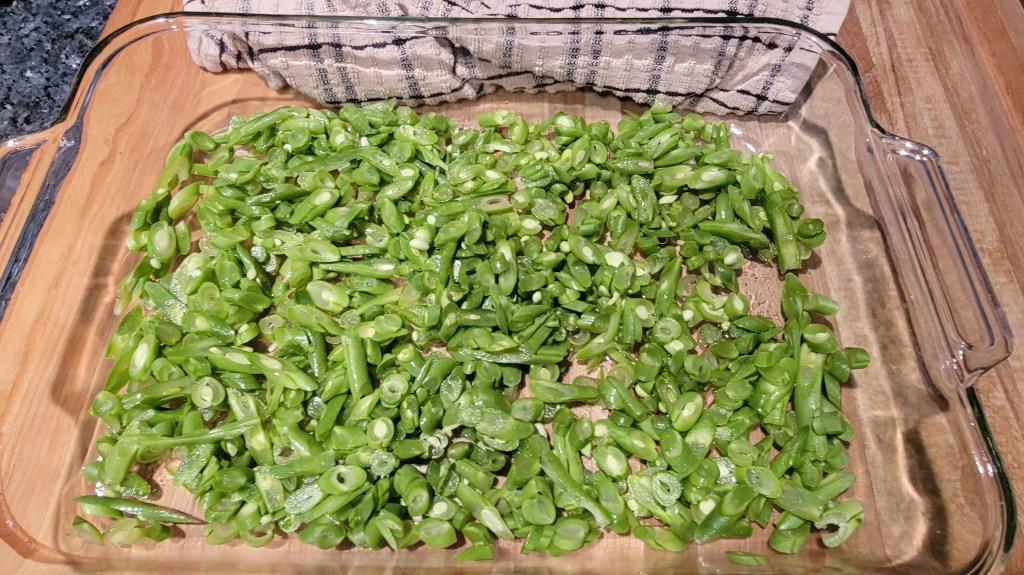
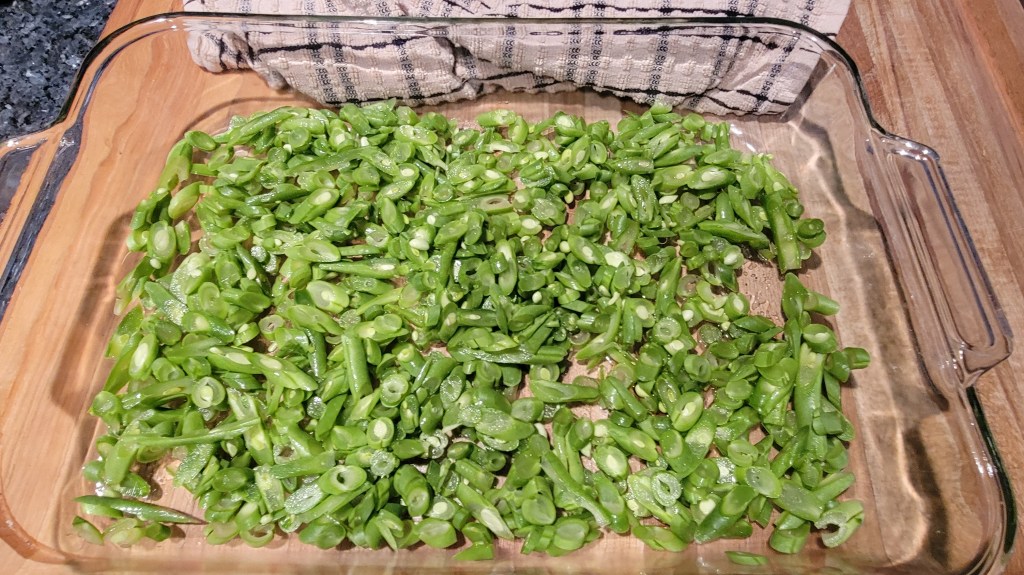
Labor Day has come and gone and we are still getting a massive volume of beautiful green beans from our garden. Furthermore, the plants are still blooming! Robert said he was going to harvest every single bean. I think a challenge is coming down from The Heavens to hold him to his declaration! If you want a new way to eat green beans, consider running them through a slicer, sprinkling with EVOO, and roasting them in the oven. This is a great way to prepare them for the freezer, too!
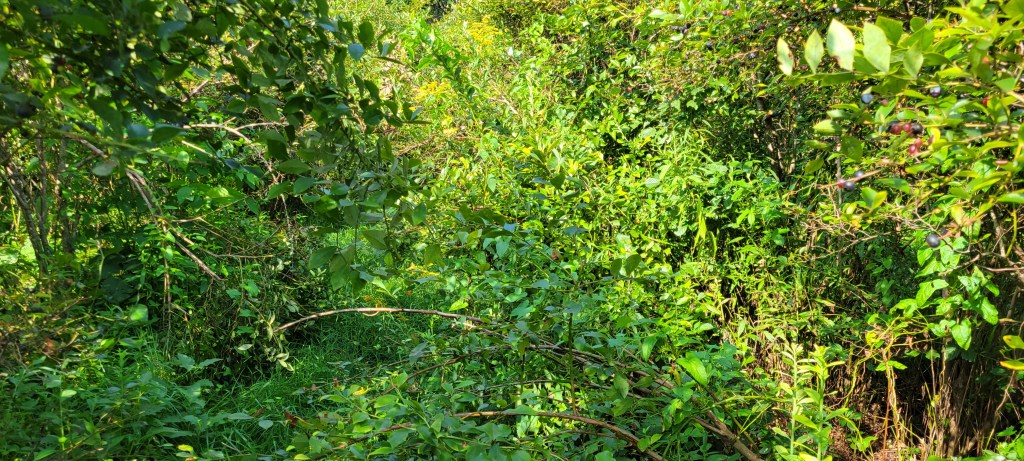
The blueberries did not turn out the way we would have liked. The rains came at the incorrect time which caused the berries to explode. Also, for the first time in thirty years, the bears decided to visit our berry patch. They did a great deal of damage to the bushes in addition to eating everything they could easily reach. You can see from this photo there is no walkway or tunnel between the rows due to the fact they pulled down and broke many plants in an attempt to reach the higher blueberries.
Everyone should have received a cantaloupe over the past couple of weeks. I put this fruit in the same category as avocados when it comes to picking a “ripe” one. I trust you got a tasty one or two! Speaking of tasty, the last potatoes you received in your veggie box are our new favorite! With its smooth skin, creamy texture, and exceptional flavor, we were particularly pleased. We just planted a few as this was a new variety which we wanted to try out, so do not expect any more this season; but you can be sure we will be planting these again next year.
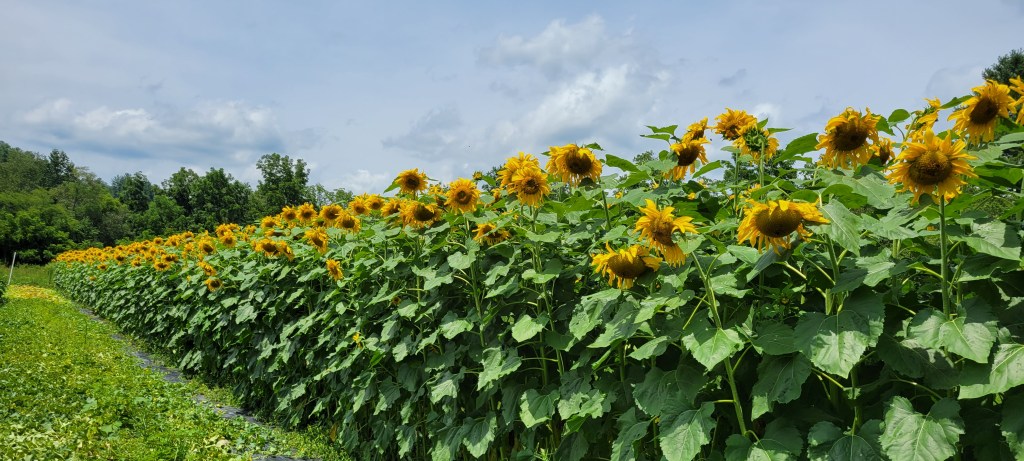
Our sunflowers were glorious this season! In two and one-half weeks, it will be Autumn. We have waves of sweet bell peppers and eggplant and tomatoes to go with the potatoes and green beans and (sometimes) okra. There will be more carrots and cabbage at some point. The peppers are just beginning to turn colors! The heat from the sun is perfect for making bell peppers sweet. The same thing goes for the tomatoes! We trust you agree they were worth the wait!
Only 1 in 10 Americans eat the recommended daily servings of fruits and vegetables. We know these poor souls are not members of our CSA as we are providing a rainbow assortment of veggies this month! The red cabbages will be limited, but eggplant (both globe and Asian), green cabbage, and sweet, bell peppers are in abundance as are the carrots, green beans, and potatoes. Yum!!!
Eggplant; green and red cabbage; sweet, bell peppers in lugs
The tomatoes are growing and will be plentiful in their designated time. Be patient! The sunflowers will soon be in bloom and provide a beautiful backdrop to the garden. The summer squash and zucchini are reaching their end, but there may be one here and there. The cucumbers are slowing down, but the plants look healthy so perhaps they will produce another wave for us.
Eggplant and peppers on the left; cucumbers in center; sunflowers on the right!
The blueberries have been a disappointment this season. That July week of rain with no sunshine caused the first batch of berries to explode. And just when we thought a second batch was ripening, rain again caused the berries to split. Added to these weather-related events, the bears have been eating our blueberries for the first time in nearly thirty years!
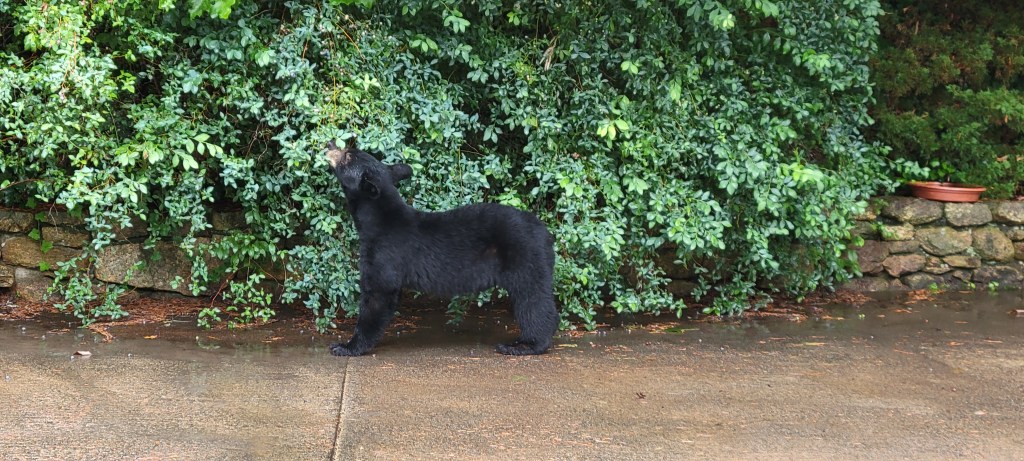
Here is Baby Bear helping himself to the blueberries by the house wall.
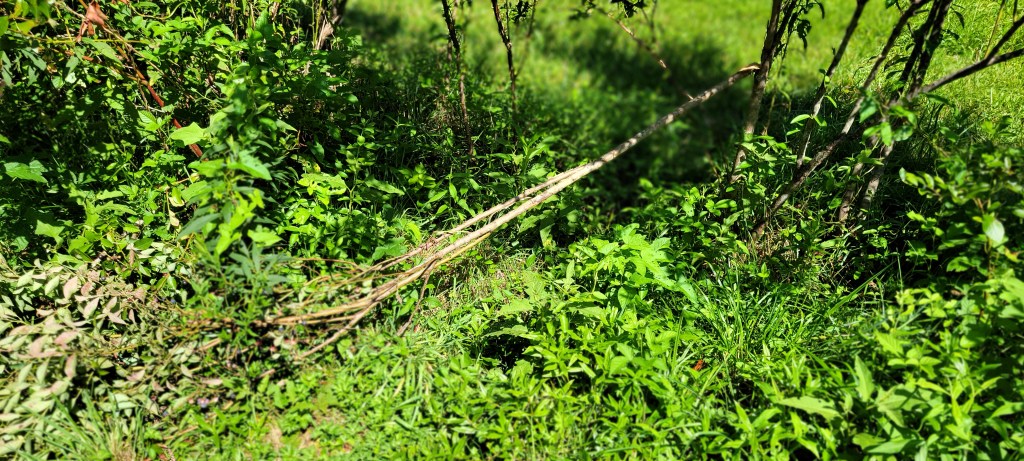
The bigger bears are not as dainty when they are eating in the field. They are doing extensive damage pulling down and breaking blueberry plant branches in an attempt to get the fruits! I suppose as more of their habitat is taken over by humans, we can expect more of this bad behavior. When houses are built in what was once their mountainside “oak acorn grove,” they must find food in more open spaces. Any CSA Member who wants to try to find some berries should send me an email and we will agree upon a time.
If you are looking for a different way to prepare green beans (or peppers, for that matter), consider running them through the food processor, mixing in some EVOO, and then roasting the beans in a 375 degree oven for about 15+ minutes. I particularly like this method for larger beans or any I plan to freeze.
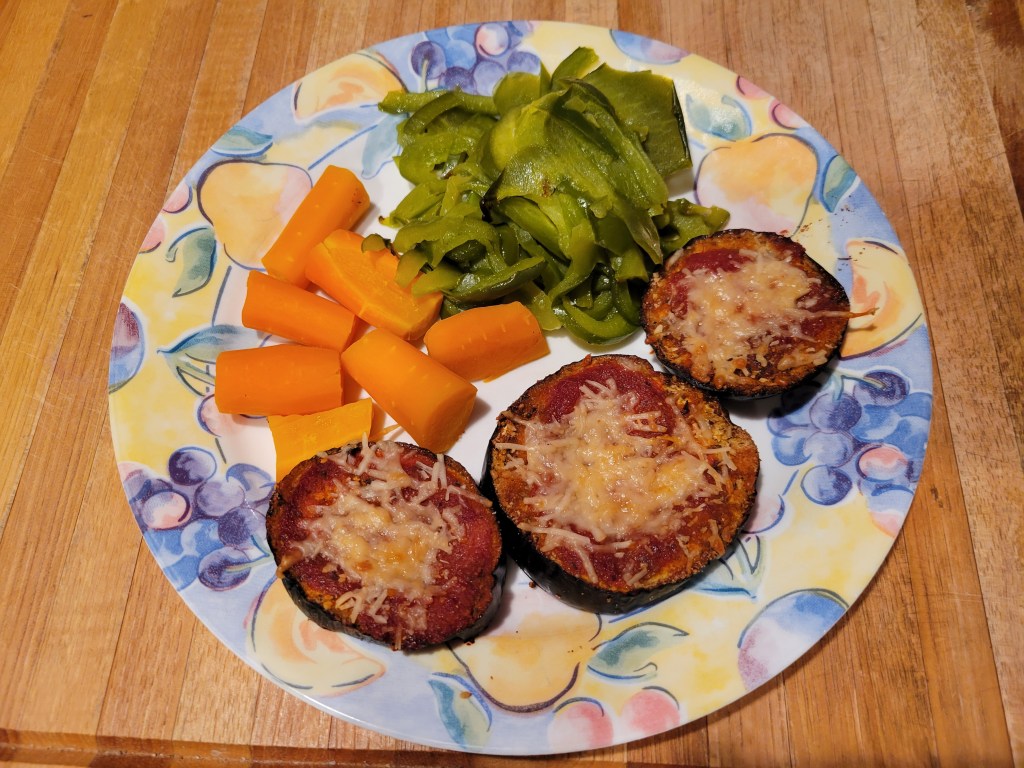
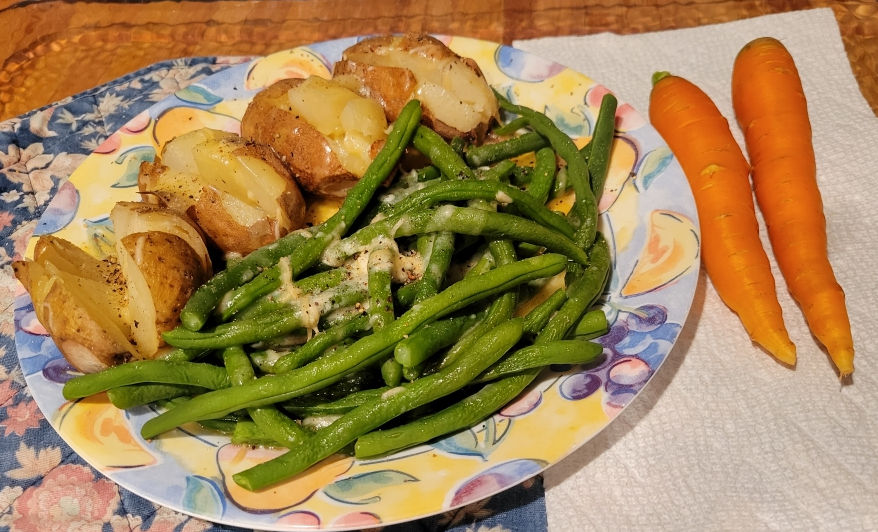
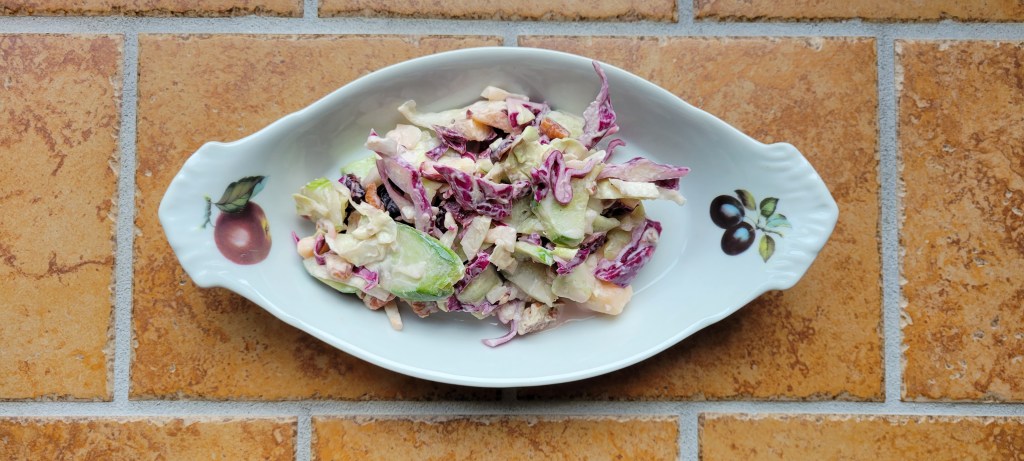
Roasting any vegetable tends to make it taste even sweeter. Below we have roasted peppers, steamed carrots, and eggplant. And russet potatoes, steamed beans, and raw carrots. And bi-cabbage coleslaw with pecans, Craisins and cucumbers in a sour cream dressing.
Recipe: Emulsify 1 cup sour cream, 2 TBSP rice vinegar, 3 TBSP honey, a dash of salt. This recipe ages well in the refrigerator!
Constant rainfall with no sunshine to dry out the plants is a problem for gardeners. It causes plants to die and veggies to rot. Thus, I feel I should give you a “heads up” when it comes to the summer squash. We are seeing some rot appear overnight. I would recommend that the summer squash is the first item you consume from your CSA Boxes. Last season our squash and zucchini only lasted two weeks before the majority of the plants were affected; but last season all of the rainfall came in one monsoon event. Still, I these daily rainfalls and cloudy days are no better. Enjoy the summer squash, zucchini, and patty pans while you can as some of our plants are dropping off. However, as you can see, we do have a plenty to choose from! As long as we can get some sunshine, we should be okay.
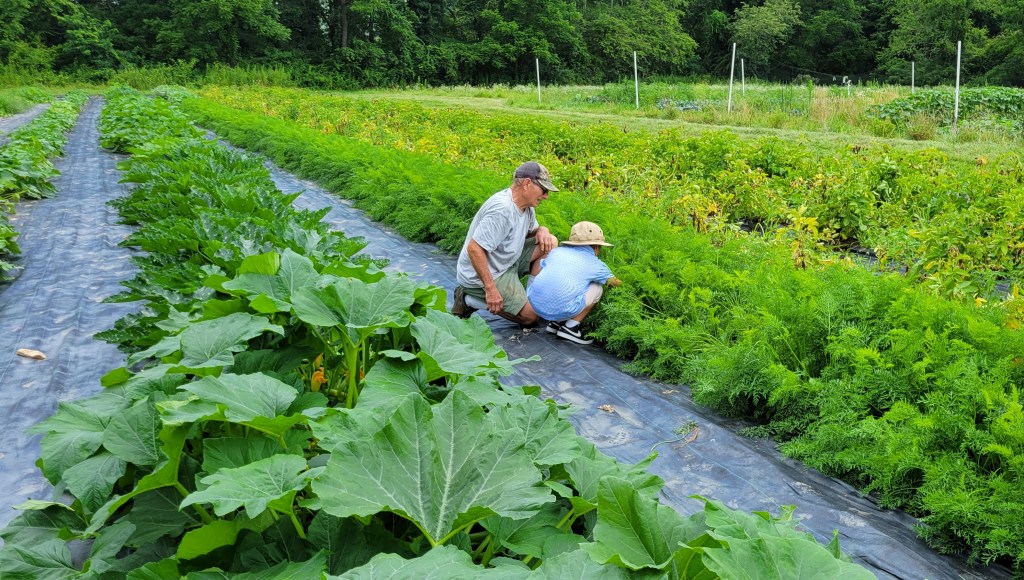
One good thing about the rainfall is it makes pulling carrots out of the soil an easy task. We have some of the most beautiful carrots we have ever grown! Perhaps it is due to the weather. Or perhaps it is due to the new method we used for planting them this year. Thirty years of growing vegetables for our families and we are still learning new things!
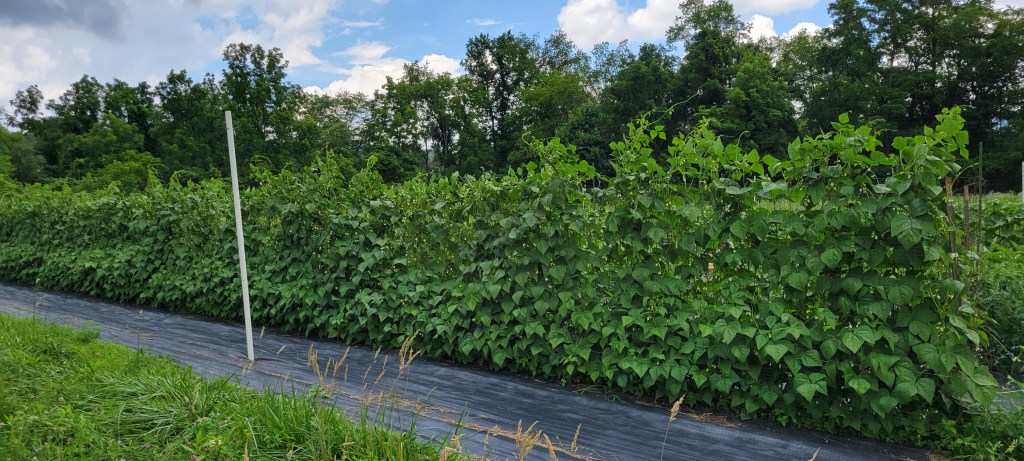
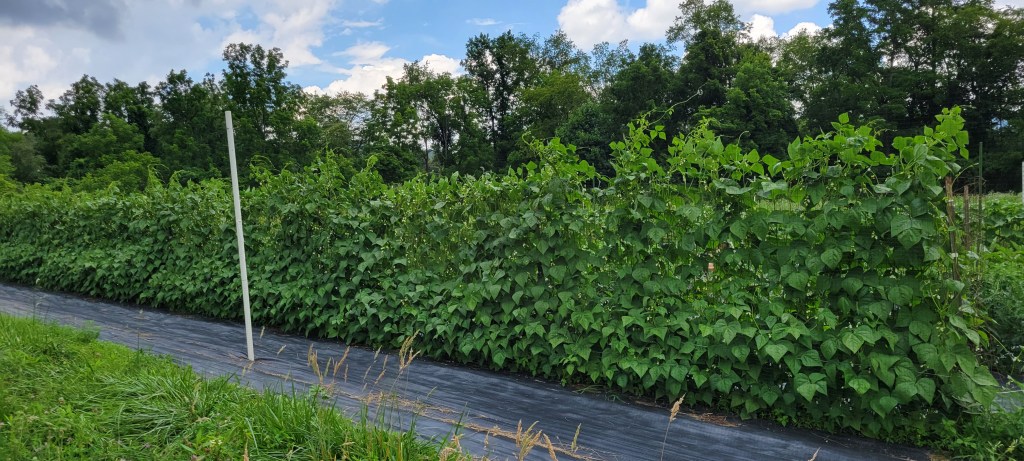
There will be green beans in the future. Our plants were looking great the day I snapped this photo. Expect a mix of the last of the broccoli and cauliflower and kohlrabi plus cabbage, carrots, cucumbers, summer squash, zucchini, and patty pan squash. Enjoy the bounty of the mid-summer garden harvest. And please pray for some sunshine!!!
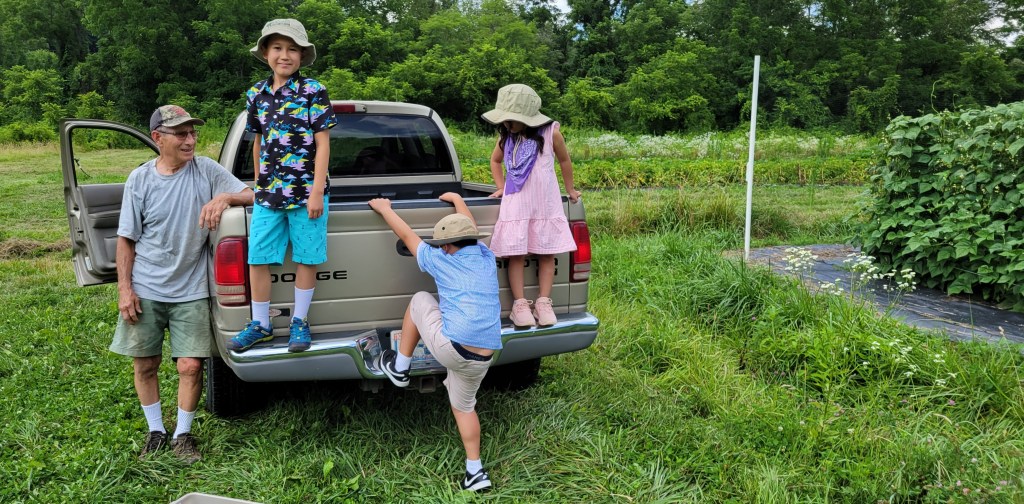
I have not written lately as we have been busy and I figured you could easily identify all of the veggies you were finding in your CSA Boxes. And besides we have been busy having fun on the farm! There is nothing like harvesting your own meal to get kids to try something new.
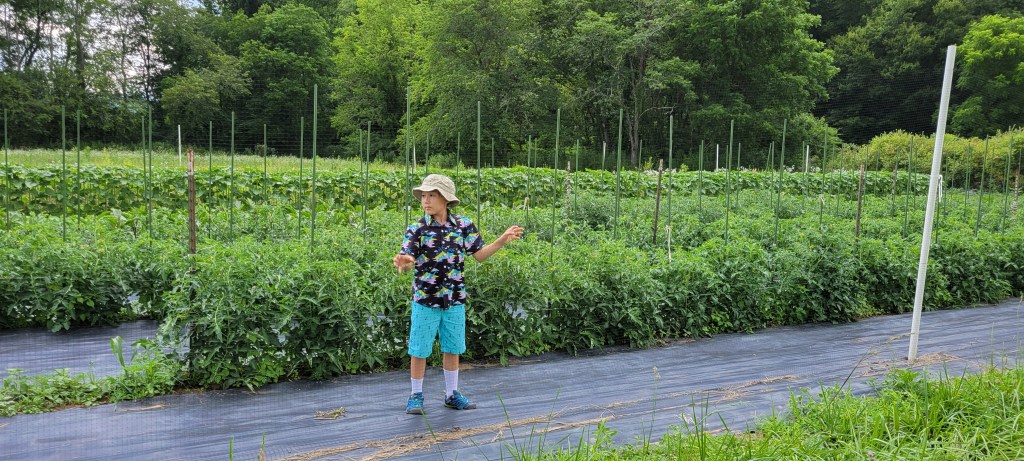
The garden has been growing like crazy! Check out the tomato plants behind this invisible deer fence in the photo below. Robert keeps tying the plants up to the stakes as they increase in height. They are late, but there will be tomatoes!
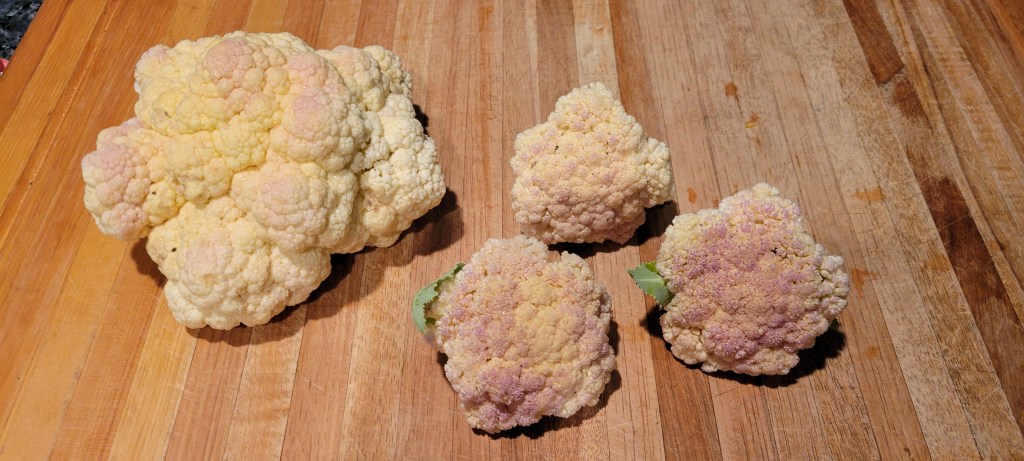
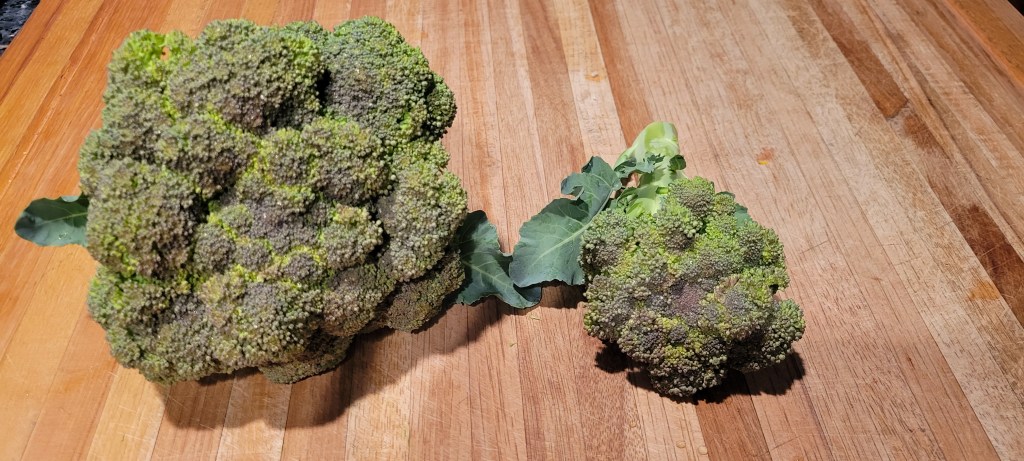
The heat has been having an effect on the garden. For example, on the left is a large cauliflower head from the first wave and on the left is a small cauliflower head from a wave affected by the high temperatures. The same thing applies to the broccoli heads.
This was one of the later broccoli varieties. Still there is a noticeable difference in the size grown under the cooler, ideal temps vs. the hot days. Actually, we are coming to the end of both of these vegetables; but it has been a great run this season!
In the upcoming boxes there will be a mix of the last of the broccoli and cauliflower and kohlrabi plus cabbage, carrots, cucumbers, summer squash, zucchini, and patty pan squash.
And coming soon will be lots and lots of green beans and the best potatoes you have ever tasted! Welcome to the summertime harvest in a very good growing season! Oh and don’t worry, children are NOT allowed to ride in the back of pickup truck . . . besides, it is usually full of veggies.
If you did not join our CSA earlier, but wish you had done so, please send me an email. The garden is plentiful this year and we could add your family for the rest of the harvest season!




 Cane Creek Asparagus & Company CSA