This is not news about our family farm–that will come later in the weekend. However, for your information, here are more details about the recent vote in the House of Representatives and what must happen next to keep our sources of food safe.
Representative Thomas Massie talks about keeping our food supply safe
We are so grateful to Representative Thomas Massie (KY) for once again standing strong for health freedom! Representative Massie uncovered our very own tax dollars being used to fund scientists who are trying to turn plants like spinach and lettuce into mRNA vaccine factories, creating a “transgenic edible vaccine.” He proposed an amendment to prohibit USDA funding of this dangerous research, and the measure passed the House of Representatives.We were able to take 10 minutes of his time to talk about how important this is, and what the battles ahead are. Watch as I get the latest from Representative Massie about his efforts to ensure our food supply is safe and protected from risky scientific experimentation.
Representative Massie is carrying the torch for health freedom. Make sure you and your friends are following SHF for updates and calls to action that will support his stand for our rights.
Vaccines Grown in Lettuce? Rep. Massie Asks House to Bar FDA, USDA From Funding Transgenic Edible Vaccines
The U.S. House of Representatives on Tuesday passed an amendment to the agricultural appropriations bill that prohibits funding for human and animal vaccines grown in genetically engineered plants. Rep. Thomas Massie (R-Ky.), who introduced the amendment, said he is concerned “we could really contaminate a lot of our food supply with unknown doses of vaccines that would deliver unknown dosages.”
The U.S. House of Representatives on Tuesday passed an amendment that would prohibit funding for transgenic edible vaccines — vaccines grown in genetically engineered plants for consumption by humans or animals.
The amendment, introduced by Rep. Thomas Massie (R-Ky.) to the agricultural appropriations bill H.R. 4368, would bar the U.S. Department of Agriculture (USDA) and the U.S. Food and Drug Administration (FDA) from funding the vaccines for fiscal year 2024.
A vote on the full bill in the House is still pending as of this writing.
In an interview with The Defender, Massie said he introduced the amendment after learning about a recent project in California, funded by a $500,000 grant from the National Science Foundation, that involves growing lettuce and trying to get the lettuce to produce mRNA vaccines that are intended to be consumed by humans who eat the lettuces.
Rep. Massie said he is concerned “that plants cross-pollinate and pollen from these modified plants, food-producing plants, could carry in the wind to other fields and contaminate them. And we could really contaminate a lot of our food supply with unknown doses of vaccines that would deliver unknown dosages.”
“Plants release pollen and it can go anywhere with the wind or with insects, and I just think it’s a bad idea,” he added.
Rep. Massie is right to be concerned,” Claire Robinson, managing editor of GMWatch, told The Defender. “Genetically engineering a potent immunogen into food plants is irresponsible in the extreme.” She added:
“All the usual risks of GM [genetically modified] plants — the DNA-damaging effects of the GM transformation process leads to changes in gene expression and biochemistry of the plant, which can include the production of toxins or allergens — apply to these vaccine-producing plants, with additional risks on top.
“In the case of vaccine-producing plants, you are intentionally engineering a plant to elicit an immune reaction. This increases the level of risk exponentially.”
‘Either they don’t work, or they are not safe, or both’
According to a 2013 scientific paper, transgenic edible vaccines “are prepared by introducing selected desired genes into plants and inducing these genetically modified plants to manufacture the encoded proteins.”
Such vaccines offer “several potential advantages” to conventional vaccine production techniques according to the paper, including a potentially lower cost of production that would be suitable for developing countries.
Efforts to develop transgenic edible vaccines are not new — scientific literature on the topic dates back to at least 1999.
What is new with some current attempts to develop transgenic edible vaccines is that they would be geared to deliver mRNA vaccines orally.
“These are all genetically modified crops,” Massie said. “They’ve been injected with mRNA or spliced with DNA, with the intent of creating copies of that RNA or DNA. The plants are pretty effective at that.”
Robinson said this approach is not new. “Scientists have been trying to produce edible vaccines in plants for many years and some testing has occurred in animals and humans.”
However, she added, “Thus far, not one plant-produced vaccine has been approved anywhere, as far as I know. What does that tell us? Either they don’t work, or they are not safe, or both,” Robinson said.
California project is ‘utter madness’
The California lettuce project that drew Massie’s attention, conducted by scientists at University of California (UC), Riverside, is described as an effort to develop “The future of vaccines,” which “may look more like eating a salad than getting a shot in the arm” via turning “edible plants like lettuce into mRNA vaccine factories.”
“The project’s goals … are threefold,” according to UC Riverside. “Showing that DNA containing the mRNA vaccines can be successfully delivered into the part of plant cells where it will replicate, demonstrating the plants can produce enough mRNA to rival a traditional shot, and finally, determining the right dosage.”
This may help overcome challenges currently facing mRNA vaccine technology, namely, “that it must be kept cold to maintain stability during transport and storage.”
Plant-based mRNA vaccines “could overcome this challenge with the ability to be stored at room temperature,” university researchers said.
Juan Pablo Giraldo, Ph.D., an associate professor at UC Riverside’s Botany and Plant Sciences Department, is leading this research project alongside scientists from UC San Diego and Carnegie Mellon University. He said, “Ideally, a single plant would produce enough mRNA to vaccinate a single person.”
“We are testing this approach with spinach and lettuce and have long-term goals of people growing it in their own gardens,” he added. “Farmers could also eventually grow entire fields of it.”
Robinson called such efforts “utter madness,” telling The Defender:
“Scientists are talking about people growing vaccine-containing plants in their gardens and farmers growing them in their fields. It is utter madness to propose to release such plants into uncontrolled conditions in this way.
“Vaccines are medicines, and their use and dosage must be carefully controlled. With any medicine, only the target patient should be treated, with their informed consent. How will these safeguards be in place if people are growing vaccines in food crops in their gardens and open fields?”
“The deployment of these transgenic edible vaccines would involve a gross violation of the Nuremberg Code on Medical Experimentation, and thus constitute a crime against humanity,” he said. “Their release into the environment would violate the Precautionary Principle of customary international environmental law. They would also be subject to the same human health objections to GMO foods that are too numerous for me to list.”
“What about cross-pollination and cross-contamination?” Robinson questioned. “People will ingest immunogens without their consent or knowledge.”
Risk of prion diseases, ‘dangerous immune reactions’
Robinson said there may also be several other unintended consequences for human health from the use of transgenic edible vaccines.
She said:
“Plant-produced vaccines will have what is known as post-translational modifications to the intended protein product. You will not end up with just the desired protein product as it exists in its native form in the pathogen. These post-translational modifications will be specific to the plant, and in humans or other animals they will produce dangerous immune reactions.
“Even the responses to the desired protein product — the ‘vaccine’ — will vary from person to person because people respond differently to different proteins. Also, you can end up with proteins that are toxic or that are not folded properly, with the latter property meaning that they could cause prion diseases.”
“In addition, it’s possible that the novel proteins will sensitize people to other things, such as foods,” Robinson said. “In an age where food allergies are increasing rapidly, do we really want to risk worsening that trend?”
Massie said there are other ways in which the human food supply could be contaminated by plant-based vaccines, noting that animals could eat plants and “that could eventually contaminate food that humans eat.”
“How do you control the dosage when you put it in food?” Massie asked. “I think it’s just a really bad idea. Even if you’re not against vaccines in general, I just think this is a really bad way to deliver vaccines to people or animals,” he said.
He added:
“I think we should have learned our lesson. If we believe that COVID-19 was a lab escape and the result of human experiments, which I do and most Americans do, then I think you should be concerned about these outdoor labs … Here we’re talking about greenhouses or open fields.”
Along similar lines, Boyle said, “We know that COVID-19 mRNA vaccines have produced a massive number of deaths and adverse events that have been thoroughly documented in the professional literature.”
“These transgenic edible vaccines would likewise be more dangerous than useless, so I wholeheartedly support Massie’s amendment,” he added.
In drawing another parallel with COVID-19, Massie likened the UC Riverside study to “science fiction.”
“Unlike some of the other research that’s been done for vaccines for animals to be grown in plants, this project in California is intended to develop vaccines for humans … I have no idea what they’re doing with this stuff. It sounds like something out of a science fiction movie,” he said.
He added:
“I think we learned from the COVID virus that you’ve got to be careful with this stuff. When you start playing God and you start modifying genes and merging DNA that’s never been merged before, you can get some unintended results. And if those escape, you can have some really bad implications or consequences.”
Similar experiments went awry
According to Massie, similar experiments with transgenic edible vaccines were conducted in the past, sometimes with government funding and support — including a project to develop transgenic alfalfa plants for edible vaccine production.
That five-year project, launched in 2016 by Fort Valley State University in Georgia, sought to “develop transgenic alfalfa plants expressing the CTB gene, which can be used in plant-based edible vaccination systems.”
The project was supported by an unspecified level of funding from the National Institute of Food and Agriculture and resulted in the publication of at least one scientific paper.
“And then there’s another instance where things went very bad,” Massie said. “About 20 years ago, they were trying to grow a vaccine to prevent diarrhea in pigs and they were using corn to grow this vaccine. The field the next year was used to grow soybeans, but the corn sprouted again.”
According to Massie, “There were some leftover kernels … and the corn was mixed with the soybeans, and it contaminated 500 bushels of soybeans that were then mixed with 500,000 bushels. And so, they had to destroy all of those soybeans.”
The New York Times reported in December 2002 that ProdiGene, the biotechnology company that developed the corn crop, agreed to pay the U.S. government a $3 million fine “to settle charges that it did not take proper steps to prevent corn that was genetically engineered to produce pharmaceuticals from entering the food supply.”
While it is unclear whether this particular project was granted U.S. government funding, an archived version of the website from 2007 of Texas A&M University’s Food Protein R&D Center, which hosted the research, said the center “collaborate[d] contractually with … state and federal research laboratories” and was “partially funded by the Texas Food and Fibers Commission.”
In November 2000, ProdiGene received an unspecified grant amount from the National Institutes of Health for the development of a transgenic edible vaccine intended to “develop genetically enhanced corn that could serve as an oral delivery system for an AIDS vaccine.”
Massie told The Defender he’s not passing a law that would prevent private organizations from doing this research, “but I’m using the appropriations process this week to try to defund the use of taxpayer dollars to develop these things.”
He said the amendment is in the form of a limitation agreement. “It doesn’t institute a law,” he said. “It will only prohibit government funding from being spent on this. So even if it’s successful, it will only last for the term of the appropriations bill, which is one year.”
“If we’re successful in stopping this through the appropriations process, we would have to do this every year,” Massie said, adding that “this amendment … only constrain[s] the FDA and USDA from doing this research. It wouldn’t actually constrain the NSF.”
For that to happen, Massie said “We’ll have to have another amendment on a different appropriations bill to keep that agency from funding this research.”
Massie pledged to introduce similar amendments if this happens.
“If that appropriations bill comes to the floor, I will offer an amendment to limit the funding for this type of research on it as well,” he said. “If the appropriations bill that funds the NSF should make it to the floor, I’ll offer this identical amendment to keep them from funding it.”
I received an email from one of our CSA Members telling me how she is dealing with all of the beautiful eggplants she has been finding in the CSA Box. I will admit to using a lazier version of Eggplant Parmesan precisely because of time constraints. However, I do lots of “batch cooking” and will try this in the future.
“We love eggplant Parmesan and the most time consuming part is breading/baking the eggplant before assembling. So I’m prepping big batches of the eggplant and freezing it for later in the fall/winter when I want to assemble the eggplant parms! (Have to make some homemade marinara to go with it!)”
If you want to try this, I suggest quick freezing the eggplant slices on parchment paper and then stacking in an airtight container or freezer bag. Putting a piece of parchment paper in between the layers of slices will prevent them from sticking to one another. This is a great time to Consider Stashing Away.
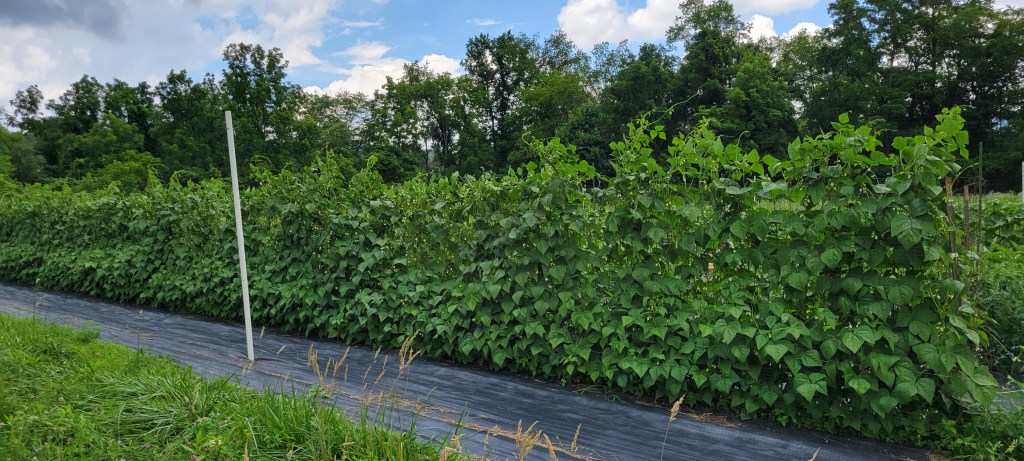
Next, I have a bean story to relate! One afternoon while Robert was harvesting beans, a dog appeared outside of the garden fence. He had a collar, but no name tag to call his family. He was friendly, so Robert petted him through the deer fence and then tossed a bean over the fence. The dog devoured the bean instantly, so Robert tossed another. This time the dog jumped to snatch the bean in mid-air! He was obviously hungry, so Robert continued tossing random beans over the fence as he continued harvesting. After about an hour, this “vegetarian” visitor went on his way with a full tummy. It has been a great season for beans and not a single one has been wasted. It seems all creatures love our Heavenly Beans!
In the box this week, you will find beans, tomatoes, eggplant, sweet bell peppers, cabbage, carrots and potatoes. The carrots keep growing larger! This is our last wave of cabbages.
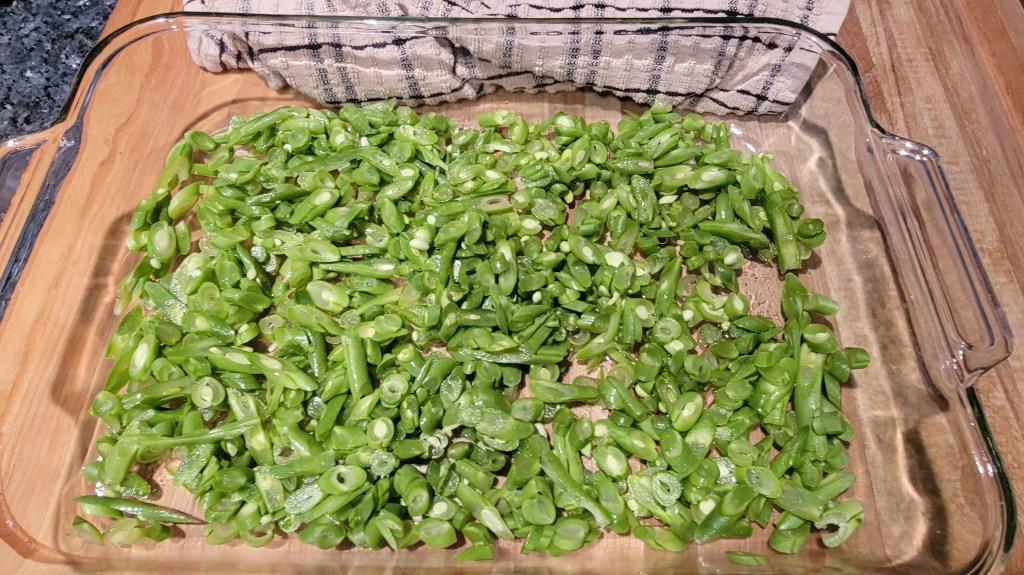
Labor Day has come and gone and we are still getting a massive volume of beautiful green beans from our garden. Furthermore, the plants are still blooming! Robert said he was going to harvest every single bean. I think a challenge is coming down from The Heavens to hold him to his declaration! If you want a new way to eat green beans, consider running them through a slicer, sprinkling with EVOO, and roasting them in the oven. This is a great way to prepare them for the freezer, too!
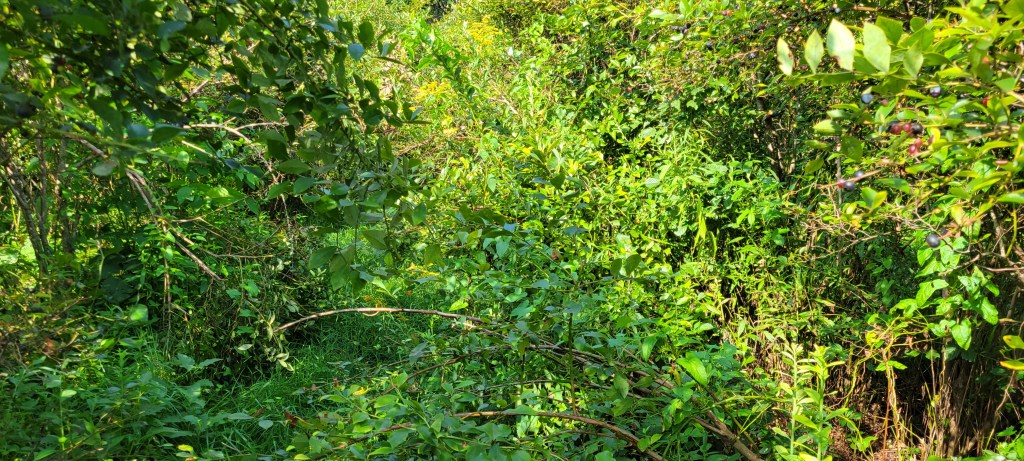
The blueberries did not turn out the way we would have liked. The rains came at the incorrect time which caused the berries to explode. Also, for the first time in thirty years, the bears decided to visit our berry patch. They did a great deal of damage to the bushes in addition to eating everything they could easily reach. You can see from this photo there is no walkway or tunnel between the rows due to the fact they pulled down and broke many plants in an attempt to reach the higher blueberries.
Everyone should have received a cantaloupe over the past couple of weeks. I put this fruit in the same category as avocados when it comes to picking a “ripe” one. I trust you got a tasty one or two! Speaking of tasty, the last potatoes you received in your veggie box are our new favorite! With its smooth skin, creamy texture, and exceptional flavor, we were particularly pleased. We just planted a few as this was a new variety which we wanted to try out, so do not expect any more this season; but you can be sure we will be planting these again next year.
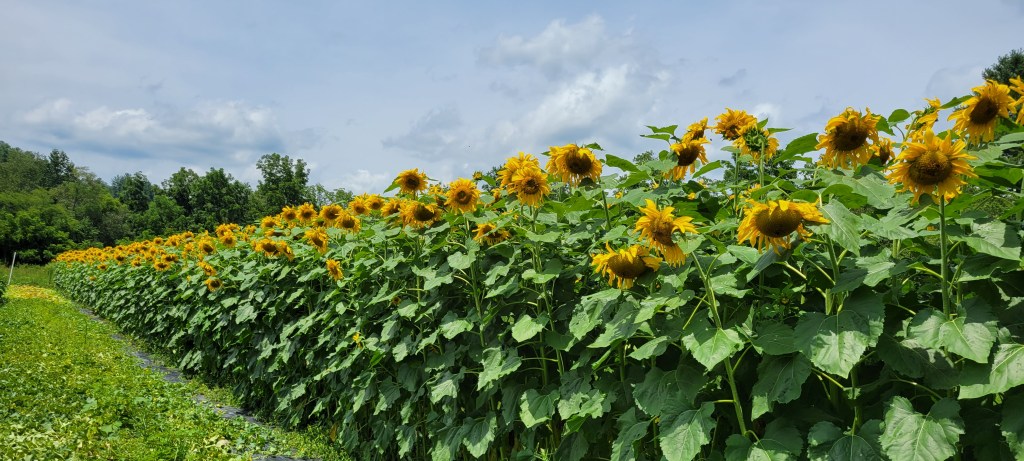
Our sunflowers were glorious this season! In two and one-half weeks, it will be Autumn. We have waves of sweet bell peppers and eggplant and tomatoes to go with the potatoes and green beans and (sometimes) okra. There will be more carrots and cabbage at some point. The peppers are just beginning to turn colors! The heat from the sun is perfect for making bell peppers sweet. The same thing goes for the tomatoes! We trust you agree they were worth the wait!


 Cane Creek Asparagus & Company CSA